
The Accidental Employer's Guide to BC Overtime Rules for Nannies and Domestic Workers
How BC employment standards apply when you hire a nanny at home: daily and weekly overtime, hour-bucket logic, statutory holiday pay, and why flat salaries without time tracking put you at risk.
Nick at RoostPay
You hired a nanny to buy back some precious time. Between managing careers, kids, and a household, the last thing you intended to become was an HR manager or a payroll accountant.
Yet, the moment you hire someone to work regular hours in your home, you become exactly that: a Nanny Employer. Some domestic worker employers mistakenly think that their nannies or personal care aides are “sub-contractors” and that they are not required to treat them as an employee. There are numerous legal tests that have been developed over time; however the rule of thumb is that if you are directing the hours of work, work conditions (location), and tasks, they are employees and not sub-contractors.
In British Columbia, navigating the Employment Standards Act (ESA) as an “accidental employer” can feel overwhelming. What happens when your meeting runs late and your nanny has to stay an extra hour? How do you handle statutory holidays?
If you are employing a Domestic Worker Employee—which includes nannies, caregivers, and housekeepers working in your private residence—you must follow BC’s specific labour laws. Here is your straightforward guide to understanding BC overtime rules and statutory holiday pay, without the legal jargon.
Understanding BC overtime rules for domestic workers
Many families try to simplify payroll by offering a flat weekly “salary.” This is a dangerous trap. In BC, you are legally required to track the actual hours your nanny works, because the law dictates when standard pay ends and overtime begins.
For domestic workers in BC, standard overtime rules apply. You must calculate overtime on both a daily and a weekly basis.
- Daily overtime: If your nanny works more than 8 hours in a single day, you must pay them time-and-a-half (1.5x their regular hourly rate) for the next four hours. If the day stretches beyond 12 hours, the rate increases to double-time (2x their regular hourly rate).
- Weekly overtime: If your nanny works more than 40 hours in a single week, any hours over 40 must be paid at time-and-a-half. (Note: You only calculate weekly overtime on the first 8 hours worked each day, to avoid “pyramiding” or paying overtime twice on the same hours).
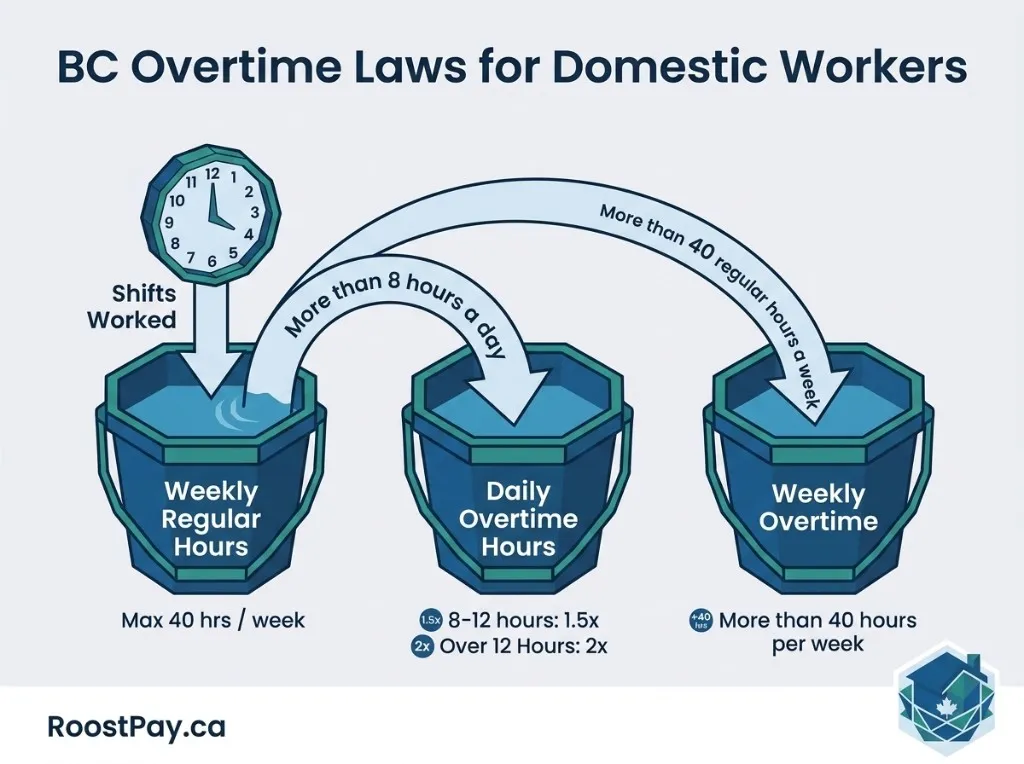
Hour buckets: Hours can be managed by imagining three buckets that get filled up over the course of a week as your nanny logs hours. The first bucket is your regular hours. This bucket can only hold 40 hours.
The second bucket is your daily overtime bucket—this bucket stores any hours worked in excess of 8 hours a day. The mandated pay rate is 1.5x for these hours, unless they are in excess of 12 hours a day and then you’re required to pay 2x.
The final bucket is the weekly overtime bucket that takes any overflow from the daily hours bucket. If a 9-hour shift is worked on the first day of the week, the first 8 hours get poured into the daily bucket and the remaining 1 hour is poured into the daily overtime bucket. Finally, once the weekly regular hour bucket is filled (40 hours) any additional hours are poured into the weekly overtime bucket. The hours in this bucket are paid at 1.5x the regular wage your nanny or domestic worker earns.
If you’ve agreed to a $25/hour rate, that late evening meeting that keeps your nanny there for a 10-hour day means those last two hours cost $37.50 each. Relying on a flat salary without tracking these extra hours leaves you vulnerable to wage claims and CRA penalties.
Demystifying BC nanny stat holiday pay
Statutory holidays add another layer of complexity. BC nanny stat holiday pay rules dictate that your employee is entitled to compensation for provincial statutory holidays, provided they meet the eligibility criteria:
- They have been employed by you for at least 30 calendar days before the statutory holiday.
- They have worked or earned wages on at least 15 of those 30 days.
If your nanny meets these criteria, the math depends on whether they work that day:
- If they have the day off: They are entitled to an average day’s pay.
- If they work on the stat holiday: You must pay them time-and-a-half for the hours they work that day, plus an average day’s pay.
Trying to calculate an “average day’s pay” for a nanny with a fluctuating schedule is exactly the kind of Friday night math most parents dread. The average pay is calculated by adding up the hours worked in the last 30 days and dividing it by the number of shifts worked during that same period.
Ditch the spreadsheet, keep the compliance
Being a household employer in British Columbia requires strict adherence to BC ESA rules, but it shouldn’t require an accounting degree. Tracking daily overtime, weekly thresholds, and statutory holiday math on a manual spreadsheet is frustrating and prone to errors.
Errors can be costly. Your employee can file a complaint even after their employment term with you had ended. If you’re found to have calculated the wrong hours, you may be held responsible for back pay and potential CRA penalties.
You don’t need to memorize the labour code; you need a system that does it for you. If the labour code changes, your system needs to update automatically to stay in compliance.
RoostPay is designed specifically for Canadian household employers. Our mobile-first platform replaces your complicated spreadsheets. Your nanny logs their hours in the app, and our compliance engine automatically calculates the exact provincial overtime rates, statutory holiday pay, and CRA tax remittances.
Take “payroll clerk” off your to-do list. See how RoostPay handles BC overtime and stat pay calculations—start with a free trial and keep compliance on autopilot.